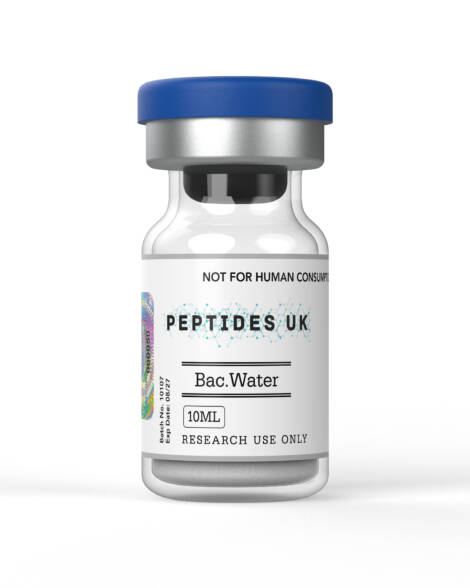
Comprehensive Guide to Sterile Laboratory Solvents
The Bacteriostatic Water Reconstitution Solution represents a foundational requirement in the in-vitro study of complex lyophilized compounds. As a highly purified and rigorously sterilized aqueous solvent, it is explicitly engineered to act as a universal diluent for synthetic amino acid chains, coenzymes, and complex glycoproteins undergoing advanced laboratory evaluation.
In contemporary molecular biology, the Bacteriostatic Water Reconstitution Solution has become an indispensable baseline standard for laboratory investigators requiring a sterile, rigorously controlled environment. By providing an optimal aqueous medium protected by an antimicrobial agent, this solution offers a uniquely comprehensive opportunity to study compound interactions without the immediate threat of rapid bacterial degradation.
Chemical and Molecular Specifications
Understanding the precise biochemical profile of the Bacteriostatic Water Reconstitution Solution is essential for ensuring accuracy during analytical testing and advanced cellular assays. This formulation is prepared to exacting standards to maintain crucial sterility during rigorous laboratory experimentation and multiple vial penetrations.
-
Primary Base: Sterile Water for Injection ()
-
Antimicrobial Agent: 0.9% Benzyl Alcohol ()
-
Molar Mass (Benzyl Alcohol): 108.14 g/mol
-
Appearance: Clear, colorless, sterile liquid.
-
Compatibility: Highly compatible with a broad spectrum of lyophilized synthetic peptides and designated laboratory buffers.
Researchers utilizing the Bacteriostatic Water Reconstitution Solution should specifically note its preservative agent. The precisely calibrated addition of 0.9% benzyl alcohol is explicitly engineered to inhibit the reproduction of bacteria, drastically extending the viable lifespan of an active, reconstituted experimental solution from a few hours to up to 28 days.
Mechanisms of Action in Laboratory Studies
The primary laboratory utility of the Bacteriostatic Water Reconstitution Solution lies in its ability to safely dissolve dry compounds without altering their fundamental molecular integrity. In controlled laboratory environments, investigators rely on this solvent to transition stable lyophilized structures into active, highly soluble states necessary for observing intracellular pathways and downstream signaling cascades.
By incorporating benzyl alcohol, the solvent acts as a highly effective bacteriostatic agent. This agent works by disrupting the biochemical pathways and membrane structures of colonizing bacteria, effectively arresting their cellular division and replication mechanisms within the experimental vial.
For a comprehensive overview of this specific antimicrobial compound and its pharmacological profile, researchers frequently reference the highly authoritative National Center for Biotechnology Information (PubChem) database, which catalogs extensive peer-reviewed data on the solvent properties, toxicity limits, and molecular structure of benzyl alcohol.
When introduced to sensitive cellular cultures via reconstituted test compounds, the strictly controlled 0.9% concentration ensures that the primary active compound retains its distinct binding kinetics and mechanisms without the preservative itself interfering in the assay’s fundamental cellular outcomes.
Common Applications in In-Vitro Research
Due to its universal necessity, the Bacteriostatic Water Reconstitution Solution is deployed across a wide spectrum of biochemical disciplines. Current in-vitro studies frequently utilize this pristine solvent to prepare complex macromolecules for immediate introduction into controlled cellular environments, ensuring the highest degree of experimental consistency.
Laboratory models focusing on systemic cellular energy homeostasis, metabolic regulation, and tissue repair rely heavily on this precise solvent to establish baseline dosing metrics. Investigators utilize the solvent to ensure accurate volumetric measurements when calculating the molarity and specific concentration-dependent responses of isolated cell populations to test compounds.
Furthermore, this solvent is utilized in prolonged experimental absorption-binding assays. Because the antimicrobial agent allows a single reconstituted vial to be used safely over multiple days, longitudinal studies can be conducted with an identical batch solution, completely eliminating the minor variations that occur when preparing fresh solutions daily.
Handling, Preparation, and Storage Protocols
To maintain maximum stability and sterility, proper handling of the Bacteriostatic Water Reconstitution Solution is absolutely essential for your laboratory operations. While less fragile than complex amino acid structures, the solvent’s sterility is highly susceptible to compromise if improperly managed during repeated vial access or long-term storage.
The compound is supplied in a sealed, sterile multi-dose vial and should be stored in a temperature-controlled environment away from direct light and atmospheric contaminants. Prior to the initial puncture, the vial can be stored at controlled room temperature (20°C to 25°C).
Once the primary seal is breached for laboratory use, the active multi-dose vial should be wiped with an isopropyl alcohol swab before every subsequent entry. Industry professionals highly recommend discarding any remaining solution exactly 28 days after the initial puncture to guarantee optimal assay integrity and prevent subtle microbial proliferation.
Quality Assurance and Third-Party Testing
At Peptide Slim Labs, we implicitly understand that reliable, verifiable data is the absolute foundation of meaningful scientific discovery. That is why our Bacteriostatic Water Reconstitution Solution undergoes rigorous third-party analytical testing to guarantee a purity level far exceeding standard industry benchmarks.
Through advanced analytical procedures, we meticulously verify the exact 0.9% concentration of the antimicrobial agent and confidently confirm the complete absence of heavy metal impurities, particulate matter, or compromised sterility. This unwavering commitment to strict, uncompromising quality control ensures your laboratory receives a pristine, verifiable solvent for all your foundational research needs.